Training New Operators to Classify Stops Correctly
Your downtime data has the accuracy of its least-trained recorder. A practical approach to teaching stop classification — designed for how people actually learn, not how the code list is organized.

A plant's downtime data carries a property nobody puts on the dashboard: it's exactly as accurate as the classification habits of the newest person on the floor. The veterans log correctly on autopilot. The operator who started three weeks ago is guessing — and their guesses flow into the same Pareto charts, the same meetings, the same decisions, indistinguishable from truth.
Most plants "train" classification the same way: here's the screen, here's the list of codes, any questions? Then everyone's surprised when the new hire's shifts show a fat "other" bar and a mysterious affection for whichever reason sits first in the list. The problem isn't the hire. It's that classification was taught as a vocabulary when it's actually a set of judgment calls.
Teach the boundaries, not the list
Nobody misclassifies the obvious stops. The gearbox failure goes under breakdown; the mold swap goes under changeover. Training time spent reciting the easy cases is wasted.
All the data damage happens at the *boundaries* — the ambiguous stops that could defensibly go two places:
- The machine jammed *during* the changeover. Changeover, or breakdown?
- The line stopped because the upstream machine starved it. Whose stop is it, and what's the reason — breakdown or material wait?
- The operator stopped the line to head off a defect they spotted. Quality? Planned? Something else?
- It restarted after the jam, ran thirty seconds, jammed again. One stop or two?
Every plant has ten or fifteen of these recurring boundary cases, and every plant has (or should have) house answers. That one-page list of *our calls on the ambiguous stops* — with a sentence of reasoning each — is worth more than any amount of code-list documentation. It's also where consistency actually comes from: two trained operators disagreeing about boundaries produce noise that no analysis downstream can remove.
Use real stops, not slides
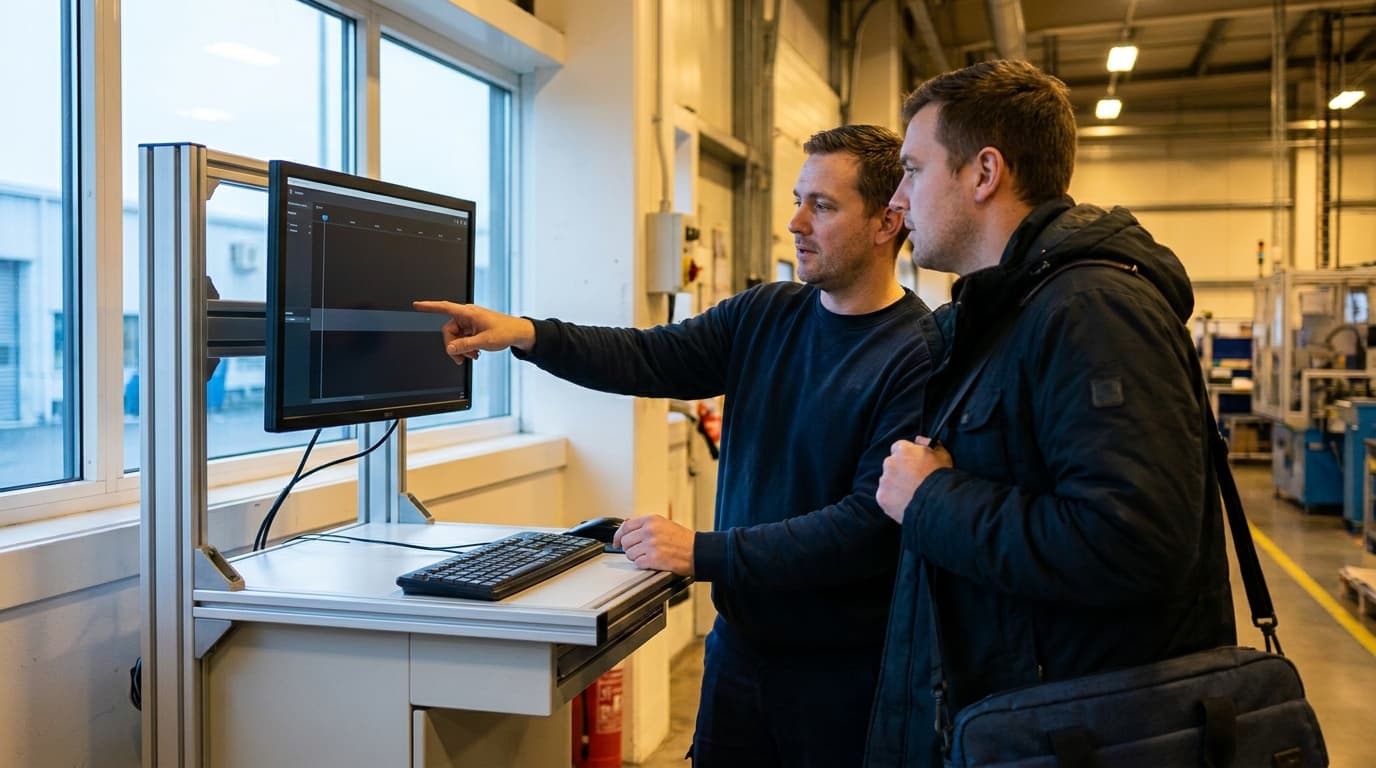
The training that sticks doesn't happen in a room. It happens at the line, during the new operator's actual first stops, with someone experienced standing there for the ten seconds of decision: "Okay — what would you log this as? … Right instinct, but we count that one as changeover, because the jam only happened because the guides weren't set yet. The rule of thumb: if the stop wouldn't have happened outside the changeover window, it belongs to the changeover."
Three or four shifts of that — classification coached at the moment of classification — beats any classroom hour. Pairing the new hire with a veteran who's explicitly told "your job this week includes teaching the logging" formalizes what good plants do accidentally.
And when a genuinely new ambiguity appears, as it will: that's not a training failure, it's the boundary list growing. Decide the call, write it down, mention it at the meeting. The list is a living document; its change history is literally your data dictionary.
Close the loop, gently
Classification quality decays without feedback — for veterans too, but fastest for new operators, who'll cement whatever habits the first month teaches them.
The feedback that works is specific, quick, and blame-free. A supervisor scanning yesterday's log spots a 25-minute "other" on a machine whose stops are never mysterious, and asks — with curiosity, not correction — "what was that one, out of interest?" The answer ("the label web kept breaking but I didn't see a code for it") is gold twice over: the operator learns the right code exists, or you learn it doesn't and the tree needs a branch.
What doesn't work is auditing silently and fixing entries from the office. The record improves; the recorder doesn't — and next week's entries are wrong in the same way. Correct the *habit*, at the source, kindly.
One more loop worth closing: show new operators what the data *does*. An hour into their first month, put the line's Pareto in front of them: "this chart decides what maintenance fixes next, and it's built from what you tap on that screen." People classify carefully when they know the classification is load-bearing — and shrug at codes that seem to vanish into a database. The single cheapest data-quality investment in the plant is making sure nobody who logs a stop thinks nobody's reading.
The compounding return
None of this is glamorous, and the payoff is invisible on any single shift. But data trust is cumulative: every correctly classified stop makes the Pareto slightly truer, the meeting slightly sharper, the fixes slightly better aimed. Plants that treat classification as a skill — taught at the line, documented at the boundaries, maintained with feedback — end up with the thing money can't directly buy: records the whole building believes.
And plants that don't? Their data is still exactly as good as the newest operator's guesses. It's just that nobody knows which entries are the guesses.