Why OEE Improvement Projects Stall After Three Months
OEE programs rarely fail loudly. They launch well, bank some early wins, and then — around month three — quietly stop mattering. The stall has mechanics, and the mechanics have fixes.
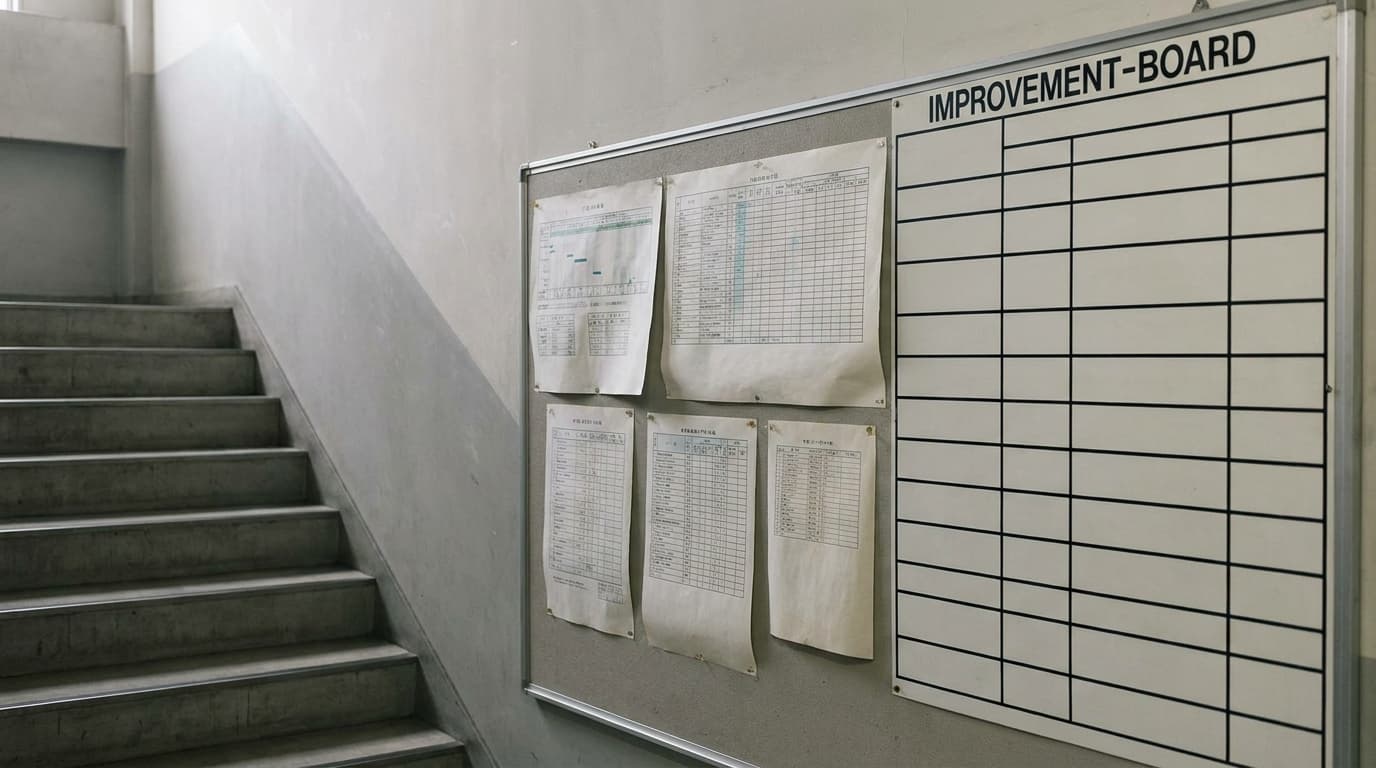
OEE programs almost never fail in a way anyone could point to. There's no cancellation memo. Instead there's a launch with real energy, six or eight good weeks, a couple of genuine wins — and then, somewhere around month three, the slow fade. The meeting gets shorter, then optional. The charts on the board stop being updated. A year later someone asks "didn't we do an OEE thing?" and nobody is quite sure when it ended, because it never officially did.
The three-month stall is predictable enough to have mechanics. Four of them, mostly.
The easy wins run out on schedule
The early weeks of any measurement program are a harvest. The first honest data exposes problems that were always there and cheap to fix — the feeder that just needed rebuilding, the changeover that shrank 40% with a staging cart. Morale is high because results are weekly.
Around month three, the harvest is over, and what's left is structurally different work: problems that need engineering time, spare-parts money, or coordination between departments. The pace of visible wins drops from weekly to quarterly — not because the program stopped working, but because the problems changed class. Teams that weren't warned this cliff was coming read the slowdown as failure and disengage.
The counter is expectation-setting plus a shift in scoreboard. Say at launch: "the first two months will be fast, then it gets slower and bigger." And when it does, start celebrating *leading* indicators — actions closed, experiments run — rather than only the OEE line, which now moves in steps, not slopes.
The champion is the single point of failure
Audit any stalled program and you usually find it was one person: a supervisor or engineer who pulled the data, ran the meeting, chased the actions. Then they got promoted, went on leave, or got consumed by a crisis — and the program revealed itself to be that person wearing a process costume.
The fix is unglamorous: the program has to be installed as *roles*, not enthusiasm. The meeting has a rotating chair. The weekly Pareto is generated automatically or by a named deputy. The action list lives somewhere public, not in the champion's notebook. A useful test: could the program survive its founder taking a month off? If the answer is no, that's the most urgent improvement project on the list — ahead of anything on the Pareto chart.
The data quietly rots
Data quality and data usage are locked in a loop, and the loop runs both directions. When logging is used — visibly, weekly — operators keep it honest. When the follow-through fades, the floor notices within weeks that nobody is reading, and the logs decay: rounder numbers, vaguer reasons, fatter "other." Which makes the analysis less useful, which makes the meeting flimsier, which further confirms nobody is reading. Six months in, the program isn't using bad data because people got lazy; the data went bad because the program stopped paying for it with action. (The full mechanics are in why operators stop logging downtime.)
The practical takeaway: data quality is a *trailing indicator of management follow-through*. When you see the logs rotting, the root cause is almost never on the floor.
Nobody above the plant asked twice
The quiet enabler of every stall: leadership sponsored the launch, attended the kickoff, and never asked about it again. Floor teams have finely tuned detectors for what leadership actually tracks versus what it blessed once. When month-three competing priorities arrive — a big order, an audit, a crisis — the program loses every scheduling conflict, not by decision but by default.
The cheapest sustaining force available is a leader who asks one specific question, monthly, forever: "what's the top loss on line 2 right now, and what are we doing about it?" Not a review meeting. One question, reliably asked, that makes the program's output somebody's expected answer. Programs with that question survive their third month. Programs without it mostly don't.
The reframe that helps
Underneath all four mechanisms is one wrong assumption: that this is a *project* — a thing with a launch, a result, and an end state. Measurement-driven improvement is closer to hygiene. It doesn't finish; it either stays funded — with attention, follow-through, and a working scoreboard — or it decays back to baseline within a couple of quarters, taking its data credibility with it.
Plan the launch. But budget for month four — that's the part that decides whether the launch was an investment or an event.